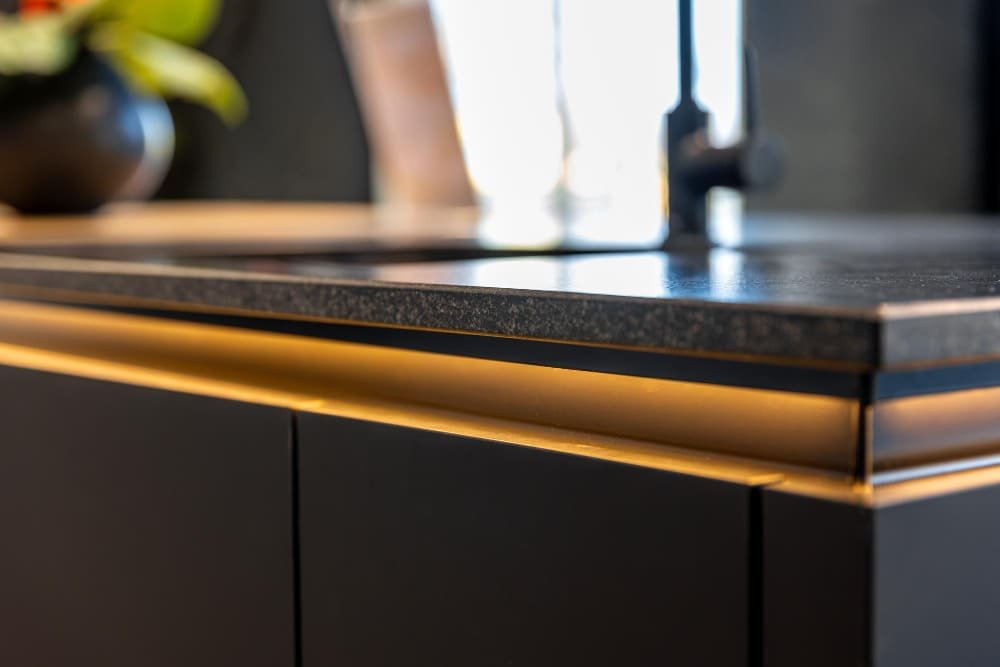
Countertop Edge Profiles: Best Options for Kitchens in Boynton Beach, FL
Choosing the right countertop material is one of the most important decisions in a kitchen renovation, but the edge profile can have an equally important influence on the finished appearance. Countertop edges define how the surface transitions at its perimeter and can make quartz, granite, marble, quartzite, or porcelain look modern, traditional, minimalist, substantial, or highly decorative.
For homeowners in Boynton Beach, FL, countertop edge profiles are especially important when designing open-concept kitchens, large islands, waterfall countertops, and custom spaces where the countertop becomes a major visual feature. The right edge should complement the material, cabinetry, kitchen style, countertop thickness, maintenance preferences, and overall design.
From simple eased edges to beveled, bullnose, ogee, and mitered profiles, homeowners have many options. However, not every edge works equally well with every material or application.
This complete guide explains the most popular countertop edge profiles for kitchens in Boynton Beach, how they differ, which options work with quartz and natural stone, and what homeowners should consider before choosing the final detail for their countertops.
What Is a Countertop Edge Profile?
A countertop edge profile is the shape created along the exposed perimeter of a countertop during fabrication.
After a slab is measured and cut according to the kitchen layout, the exposed edges are finished according to the selected profile. Depending on the material and design, the edge can be almost straight, slightly rounded, heavily curved, beveled, decorative, or fabricated to create the appearance of a much thicker countertop.
Although the edge represents a relatively small portion of the overall surface, it is highly visible.
The profile affects how light interacts with the countertop, how thick the slab appears, how easy the perimeter is to clean, and how the countertop coordinates with cabinets and other architectural details.
Why Countertop Edges Matter
Countertop edges should not be treated as an afterthought.
Two kitchens using exactly the same slab can look very different simply because different edge profiles were selected.
Countertop Edges Influence Kitchen Style
Simple profiles generally create a cleaner and more contemporary appearance.
Decorative profiles introduce more architectural detail and can complement traditional or transitional cabinetry.
A thick mitered edge can make an island appear more substantial and luxurious, while a minimal eased edge allows the stone itself to remain the primary visual feature.
Countertop Edges Affect Maintenance
Profiles containing multiple curves and decorative details may require slightly more attention during cleaning than simple edges.
A clean eased profile, for example, has fewer detailed areas where crumbs or residue can collect.
Maintenance differences are generally manageable, but homeowners who prioritize simplicity should consider edge design as part of their decision.
Edge Profiles Can Affect Project Cost
Some countertop edges require substantially more fabrication than others.
A basic eased edge may be included within standard fabrication pricing, depending on the fabricator, while elaborate profiles and mitered construction may require additional labor.
The material itself also affects fabrication complexity. Hard natural stone and large-format porcelain can require specialized equipment and experience.
Eased Edge Countertops
The eased edge is one of the most versatile countertop edge profiles.
It creates a mostly straight appearance with the sharp corners slightly softened.
The result is clean, understated, and compatible with many kitchen styles.
Why Choose an Eased Edge?
An eased edge allows the countertop material to receive most of the visual attention.
This can be especially effective with dramatically veined quartzite, marble, granite, or marble-inspired quartz because an elaborate edge may compete with the pattern of the surface.
Eased edges are also relatively simple to clean and work with contemporary, transitional, and many traditional kitchens.
Best Applications for Eased Edges
Eased edges are excellent for perimeter countertops, large islands, modern kitchens, and spaces where homeowners want a timeless profile.
They also work well when the design includes other strong elements such as dramatic backsplashes, statement lighting, or highly detailed cabinetry.
Straight Edge Countertops
The term “straight edge” is frequently used to describe a countertop that appears completely square.
In practice, the exposed corner is usually softened slightly rather than left dangerously sharp.
This creates the visual impression of a straight architectural line while making the countertop more practical for everyday use.
Modern Kitchen Applications
Straight-looking edges complement contemporary cabinetry with flat-panel doors, minimalist hardware, and simple architectural lines.
They can also make countertops appear more substantial because the vertical face remains visually prominent.
For homeowners designing modern kitchens in Boynton Beach, a clean straight profile can provide an understated foundation for the rest of the room.
Beveled Edge Countertops
A beveled edge features an angled cut along the upper portion of the countertop perimeter.
Rather than transitioning directly from the horizontal surface to the vertical face, the bevel creates an additional geometric plane.
Why Choose a Beveled Edge?
Beveled edges add visual detail without becoming overly decorative.
They work particularly well in transitional kitchens where homeowners want something more distinctive than a basic eased edge but less ornate than an ogee profile.
The angled surface can also interact attractively with kitchen lighting, emphasizing the edge of the countertop.
Materials for Beveled Edges
Beveled edges can be fabricated on many quartz and natural stone countertops when material thickness and fabrication requirements allow.
The exact dimensions of the bevel should be discussed with the fabricator because small differences can significantly affect the final appearance.
Bullnose Countertop Edges
Bullnose edges create a rounded countertop perimeter.
A full bullnose generally rounds both the upper and lower portions of the edge, producing a smooth curved profile.
Advantages of Bullnose Edges
The absence of prominent corners creates a softer appearance.
Bullnose edges have historically been popular in traditional kitchens and can still work well in homes where curved details complement cabinetry and architectural elements.
The rounded perimeter can also feel comfortable in areas where people frequently stand or move close to the countertop.
Potential Disadvantages
Because the bottom portion curves inward, liquids reaching the edge may sometimes follow the curve rather than dropping directly toward the floor.
The softer appearance may also feel less consistent with highly minimalist contemporary kitchens.
Whether this matters depends on the homeowner’s priorities and overall design.
Half Bullnose Countertop Edges
A half bullnose, sometimes called a demi-bullnose depending on the fabricator and exact profile, creates a rounded upper edge while retaining more definition along the lower portion.
This provides some of the softness of a full bullnose without creating a completely rounded appearance.
Why Choose a Half Bullnose?
A half bullnose can work well when homeowners want a comfortable curved edge while preserving more visual thickness.
It can complement transitional kitchens and natural stone countertops without introducing excessive decorative detail.
Because terminology varies between fabricators, homeowners should review an actual edge sample or drawing rather than relying solely on the profile name.
Ogee Countertop Edges
The ogee is one of the most recognizable decorative countertop edge profiles.
It generally combines concave and convex curves to create an elegant architectural detail.
Where Ogee Edges Work Best
Ogee edges are often associated with traditional and luxury kitchens.
They can complement raised-panel cabinetry, decorative molding, elaborate range hoods, and other classic architectural details.
Granite and marble countertops have historically been popular applications for ogee edges, although suitability depends on slab thickness and fabrication requirements.
When to Avoid an Ogee Edge
In a minimalist kitchen with flat cabinetry and simple lines, an elaborate ogee profile may feel visually disconnected.
It can also compete with highly dramatic stone.
If a quartzite or marble slab already contains significant movement, a simpler edge may allow the natural pattern to become the main design feature.
Mitered Edge Countertops
Mitered edges have become particularly popular in luxury contemporary kitchens.
Unlike a profile created only by shaping the exposed edge of a slab, a mitered design typically joins pieces at an angle to create the appearance of a thicker countertop.
Why Mitered Edges Are Popular
A mitered edge can make a countertop appear substantially thicker without requiring a solid slab of the same visual thickness.
This creates a bold architectural appearance that works especially well on large kitchen islands.
Mitered fabrication can also allow pattern movement to continue from the horizontal surface down the vertical face when carefully planned.
Mitered Edges Require Precision
Mitered edges demand accurate cutting, assembly, finishing, and pattern alignment.
With natural stone, vein movement should be considered before fabrication.
With porcelain and other manufactured slabs, careful alignment can also be important when the surface contains prominent patterns.
Because fabrication is more complex, mitered edges can cost more than simpler profiles.
Waterfall Countertop Edges
A waterfall countertop is technically more than a traditional edge profile, but it is frequently considered during the same design decision.
Instead of stopping at the horizontal surface, the countertop material continues vertically down the side of an island or cabinet toward the floor.
Why Choose a Waterfall Countertop?
Waterfall designs create a strong architectural focal point.
They are particularly effective in open-concept kitchens where the island is visible from living or dining areas.
Quartz, quartzite, marble, granite, and porcelain may all be considered for waterfall applications depending on the specific material, slab dimensions, fabrication requirements, and design.
Vein Matching for Waterfall Islands
When the selected material contains dramatic veining, pattern alignment becomes especially important.
Experienced fabricators can plan slab cuts so the movement of the stone appears to transition intentionally from the horizontal countertop onto the vertical panel.
The result can make a kitchen island feel like a continuous sculptural element.
Laminated and Built-Up Countertop Edges
Another method of creating the appearance of additional countertop thickness is a built-up or laminated edge.
Additional material is fabricated along the exposed perimeter to create a thicker visual profile.
When a Built-Up Edge Makes Sense
Built-up edges can be useful when homeowners want a substantial countertop appearance or when the design calls for greater visual weight.
The success of this technique depends heavily on fabrication quality and how well the added material integrates with the primary surface.
Patterned materials require particularly careful planning because poorly aligned seams can make the construction more noticeable.
Best Countertop Edge for Quartz
Quartz provides substantial flexibility in edge design.
Simple eased, beveled, bullnose, and various decorative profiles may be available depending on the specific product, thickness, and fabricator.
Modern Quartz Kitchens
For contemporary kitchens, an eased or straight-looking edge is often an effective choice.
These profiles complement the consistency and clean appearance of engineered quartz.
Mitered edges can also create a dramatic appearance on islands, particularly with quartz designs inspired by marble.
Traditional Quartz Kitchens
Beveled, bullnose, or more decorative profiles can help quartz coordinate with traditional cabinetry.
Rather than selecting an edge independently, consider the cabinet doors, crown molding, hardware, backsplash, and other architectural details.
Best Countertop Edge for Granite
Granite can support many edge profiles and has historically been used with everything from simple eased edges to detailed ogee designs.
Let the Granite Pattern Influence the Edge
If your granite has dramatic movement or strong mineral variation, a simple profile can prevent the design from becoming visually overwhelming.
More uniform granite can accommodate decorative edges without creating as much visual competition.
The final profile should also account for slab thickness and any natural characteristics near the perimeter.
Best Countertop Edge for Quartzite
Quartzite is often selected because of its natural veining and premium appearance.
For this reason, many homeowners prefer understated edges that allow the stone itself to remain the focus.
Eased Edges for Quartzite
An eased profile works exceptionally well with dramatic quartzite because it provides a clean frame without competing with the slab.
Mitered Quartzite Edges
A mitered edge can create a spectacular statement island when executed properly.
However, quartzite is very hard and can be demanding to fabricate. Experience, appropriate equipment, and careful planning are particularly important for complex quartzite edges.
Best Countertop Edge for Marble
Marble works with both simple and decorative profiles.
The right choice depends heavily on the architecture of the kitchen.
Traditional Marble Kitchens
Ogee, bullnose, and other detailed profiles can reinforce a classic appearance.
These edges can work particularly well with traditional cabinetry and architectural molding.
Contemporary Marble Kitchens
For a contemporary kitchen, an eased or straight-looking edge can provide a cleaner aesthetic while allowing the natural veining to remain the focal point.
Because marble can be vulnerable to chipping and etching, homeowners should also discuss practical edge considerations with their fabricator.
Best Countertop Edge for Porcelain
Porcelain requires a different approach because many large-format porcelain slabs have thinner profiles than traditional stone countertops.
Simple exposed edges and mitered fabrication are common approaches depending on the product and design.
Mitered Porcelain Edges
Mitered fabrication can create the appearance of a much thicker porcelain countertop.
This works particularly well in contemporary kitchens and on waterfall islands.
Because porcelain requires specialized fabrication techniques, homeowners should work with professionals experienced with the specific material.
Best Countertop Edge for a Kitchen Island
Kitchen islands frequently become the centerpiece of modern kitchens.
The appropriate edge depends on whether the island should blend into the room or function as a statement feature.
For a Clean and Timeless Island
Choose an eased or simple straight-looking edge.
These options allow cabinetry, lighting, seating, and the countertop material to create the visual impact.
For a Luxury Statement Island
Consider a mitered edge or waterfall design.
These approaches can create a substantial architectural feature, particularly when combined with dramatic quartzite, marble-inspired quartz, or porcelain.
Best Countertop Edges for Small Kitchens
Small kitchens usually benefit from visual simplicity.
An overly decorative countertop edge can introduce additional visual detail into a space that already contains cabinetry, appliances, backsplash, hardware, and flooring.
Eased and simple beveled edges can provide definition without overwhelming the room.
Light countertops combined with clean edge profiles can also contribute to a more open visual appearance.
Best Countertop Edges for Large Kitchens
Large kitchens provide more flexibility.
A substantial island can support a thicker-looking mitered edge, while perimeter countertops may use a simpler profile.
Using different but compatible treatments can create visual hierarchy.
However, the design should remain cohesive. Introducing too many edge styles within the same kitchen can make the space feel unnecessarily complicated.
Countertop Edge Profiles for Modern Kitchens
Modern kitchens generally emphasize simple lines, limited ornamentation, and architectural proportions.
Eased, straight-looking, mitered, and waterfall edges are particularly compatible with this approach.
The goal is usually to create clean transitions rather than decorative detail.
Flat-panel cabinetry, integrated appliances, slab backsplashes, and minimalist hardware can reinforce the same aesthetic.
Countertop Edge Profiles for Traditional Kitchens
Traditional kitchens can accommodate greater decorative detail.
Bullnose, ogee, beveled, and other shaped profiles can coordinate with raised-panel cabinetry, decorative moldings, detailed range hoods, and classic hardware.
The edge should still be proportional to the countertop and cabinetry.
An excessively elaborate edge can overwhelm a relatively simple kitchen.
Countertop Edge Profiles for Transitional Kitchens
Transitional design combines traditional warmth with contemporary simplicity.
For this reason, eased, beveled, and softly rounded profiles often work particularly well.
These edges provide enough detail to complement traditional elements without making the countertop feel overly ornate.
Which Countertop Edge Is Easiest to Clean?
Simple profiles are generally easiest to maintain.
Eased and straight-looking edges have relatively few curves or decorative areas where residue can accumulate.
More detailed profiles such as ogee edges may require slightly more attention during cleaning.
The difference is usually manageable, but homeowners who prioritize low maintenance may prefer simpler profiles.
Which Countertop Edge Is Most Durable?
Durability depends on the material, edge geometry, fabrication quality, installation, and how the countertop is used.
No edge profile can make a countertop completely resistant to chipping.
Sharp-looking corners may be more vulnerable to impact than more rounded designs, while decorative profiles introduce additional shaped areas that require careful fabrication.
A fabricator can recommend an appropriate edge based on the specific slab rather than relying on a universal rule.
Countertop Edges for Homes With Children
Households with young children may prefer softened countertop edges rather than highly defined corners.
Bullnose, half bullnose, and eased profiles can reduce the sharpness of exposed countertop corners.
However, edge selection alone does not eliminate injury risk. Kitchen layout, countertop height, corners, overhangs, and general childproofing should also be considered.
How Countertop Thickness Affects Edge Selection
Countertop thickness influences how an edge profile appears.
A decorative profile needs enough material to create the intended shape, while mitered fabrication can create the visual impression of a much thicker surface.
Homeowners should avoid selecting an edge from an online photograph without considering the thickness of their actual material.
The same profile can look substantially different on different slabs.
How Much Do Countertop Edge Profiles Cost?
Countertop edge pricing varies according to material, profile complexity, countertop dimensions, fabricator, and project requirements.
Simple profiles may be included within standard fabrication pricing, while decorative, built-up, and mitered edges may involve additional charges.
Instead of relying on a generic price per linear foot, request a project-specific estimate.
Why Complex Edges Cost More
Complex edges require additional fabrication time, equipment, finishing, and craftsmanship.
Mitered construction also involves multiple pieces and precise alignment.
With dramatically patterned stone, additional planning may be necessary to preserve visual continuity.
Common Countertop Edge Mistakes to Avoid
One common mistake is choosing an edge based entirely on a photograph without considering the actual material and thickness.
Another is selecting a highly decorative edge that conflicts with the architecture of the kitchen.
Homeowners should also avoid assuming that every profile can be fabricated successfully on every material.
The condition of the slab, thickness, reinforcement requirements, sink location, overhangs, and fabrication limitations can all affect the available options.
Finally, do not wait until the last moment to discuss edges. The profile should be established before fabrication begins.
Should the Kitchen Island and Perimeter Have the Same Edge?
Not necessarily.
Using the same edge throughout the kitchen creates consistency, but the island can also receive a more substantial treatment.
For example, perimeter countertops might use a simple eased edge while the island uses a mitered profile.
This can emphasize the island without introducing an entirely different design language.
The important factor is that both profiles feel intentional and compatible.
Should Countertop Edges Match the Backsplash?
The countertop edge and backsplash do not need to match because they perform different visual functions.
However, they should belong to the same overall design.
A kitchen with a dramatic full-height slab backsplash may benefit from a simple countertop edge.
If the backsplash is understated, the countertop edge can carry slightly more architectural detail.
Balance is generally more important than exact matching.
How to Choose the Right Countertop Edge Profile
Start with the overall style of your kitchen.
Determine whether the space is modern, traditional, transitional, coastal, minimalist, or another design direction.
Then evaluate the countertop material.
Highly patterned stone may benefit from a simple edge, while a quieter surface can support more decorative detail.
Next, consider daily use and maintenance. Households seeking easy cleaning may prefer straightforward profiles.
Finally, evaluate the countertop thickness, cabinetry, island design, and budget before approving the edge.
See Countertop Edge Samples Before Choosing
Edge terminology can vary between countertop companies.
One fabricator’s demi-bullnose may not look exactly like another company’s version.
For this reason, homeowners should review physical edge samples, drawings, or completed project examples whenever possible.
This is particularly important for decorative and mitered profiles.
Seeing the edge at the same thickness as your selected material can provide a much more accurate understanding of the finished result.
Questions to Ask Your Countertop Fabricator
Before fabrication begins, ask which edge profiles are recommended for your selected material and thickness.
Confirm whether the edge is included in the estimate or carries an additional fabrication charge.
For mitered edges, ask how corners and patterns will be aligned.
For natural stone, discuss whether any characteristics of the selected slab affect the proposed profile.
If your kitchen includes an island, ask whether using a different edge on the island would improve the overall design.
Professional Countertop Fabrication in Boynton Beach, FL
Countertop edge quality depends heavily on fabrication.
Precision cutting, shaping, polishing, and finishing help ensure that the edge looks consistent throughout the project.
Complex designs require even greater attention.
Mitered edges, waterfall panels, decorative profiles, and heavily veined natural stone should be carefully planned before cutting begins.
Working with experienced countertop professionals allows these decisions to be incorporated into the complete fabrication strategy rather than treated as last-minute details.
Countertop Edge Profiles in Boynton Beach, FL
For homeowners comparing countertop edge profiles in Boynton Beach, the best option depends on more than current design trends.
Your countertop material, kitchen architecture, cabinetry, island dimensions, lifestyle, and budget should all influence the decision.
Eased edges provide timeless versatility. Beveled profiles introduce subtle architectural detail. Bullnose edges create a softer appearance. Ogee edges complement traditional kitchens, while mitered and waterfall designs can create dramatic contemporary focal points.
The goal is not to select the most elaborate edge. It is to choose the profile that makes the countertop and kitchen work together.
Conclusion
Countertop edge profiles can significantly influence the finished appearance of a kitchen in Boynton Beach, FL.
A simple eased edge can highlight dramatic quartzite or granite without competing with the stone. A beveled profile can add subtle detail to a transitional kitchen. Bullnose and ogee edges can complement traditional designs, while mitered and waterfall countertops can create bold architectural statements in contemporary spaces.
Material selection is equally important. Quartz, granite, marble, quartzite, and porcelain have different fabrication characteristics, meaning the ideal edge should be chosen with the actual countertop material in mind.
Before making your final decision, compare edge samples, consider countertop thickness, discuss fabrication requirements, and evaluate how the profile will interact with your cabinets, backsplash, island, and overall kitchen design.
The right countertop edge may be a small detail, but it can make a significant difference in creating a kitchen that feels intentional, polished, and complete.
Explore Countertop Edge Options in Boynton Beach, FL
If you are planning new kitchen countertops in Boynton Beach, FL, our team can help you compare materials, edge profiles, slab designs, finishes, and fabrication options for your project.
Visit us at 1200 SW 35th Ave Suite D, Boynton Beach, FL 33426 to explore premium natural stone and quartz surfaces and discuss the best countertop edge profile for your kitchen.
From material selection and precise measurements to custom fabrication and professional installation, we help homeowners and commercial clients throughout Boynton Beach and surrounding South Florida communities create countertops designed around their space, style, and everyday needs.